49. Machine Learning with a Honk turns one!
Reflections on a year of growth and what is coming next

Once upon a time…
Exactly one year ago, during the Christmas holidays, I launched this Substack and started my personal journey as a content creator. It has been a wild ride since that first post, and almost 50 articles later, it’s a good time to review the progress and adjust focus to keep having fun.
Before we do so, let me express my gratitude to everyone who read, shared, or engaged with my content: the response was very positive from the beginning, which kept my motivation high week after week. With that said, here is my perspective on the current status of things.
Things that went well
Let’s begin with the good news: I started something! Believe it or not, I had never done it at scale before. Now, it is not a company and does not generate any revenue at the moment (those $96 are not real), but it genuinely feels great because success was not guaranteed.
In twelve months, 1200 people decided it was not annoying to receive an email every week, while many more read sporadically and pushed the views of top articles to several times that amount. It is also encouraging to see that recent posts consistently attract a larger audience.
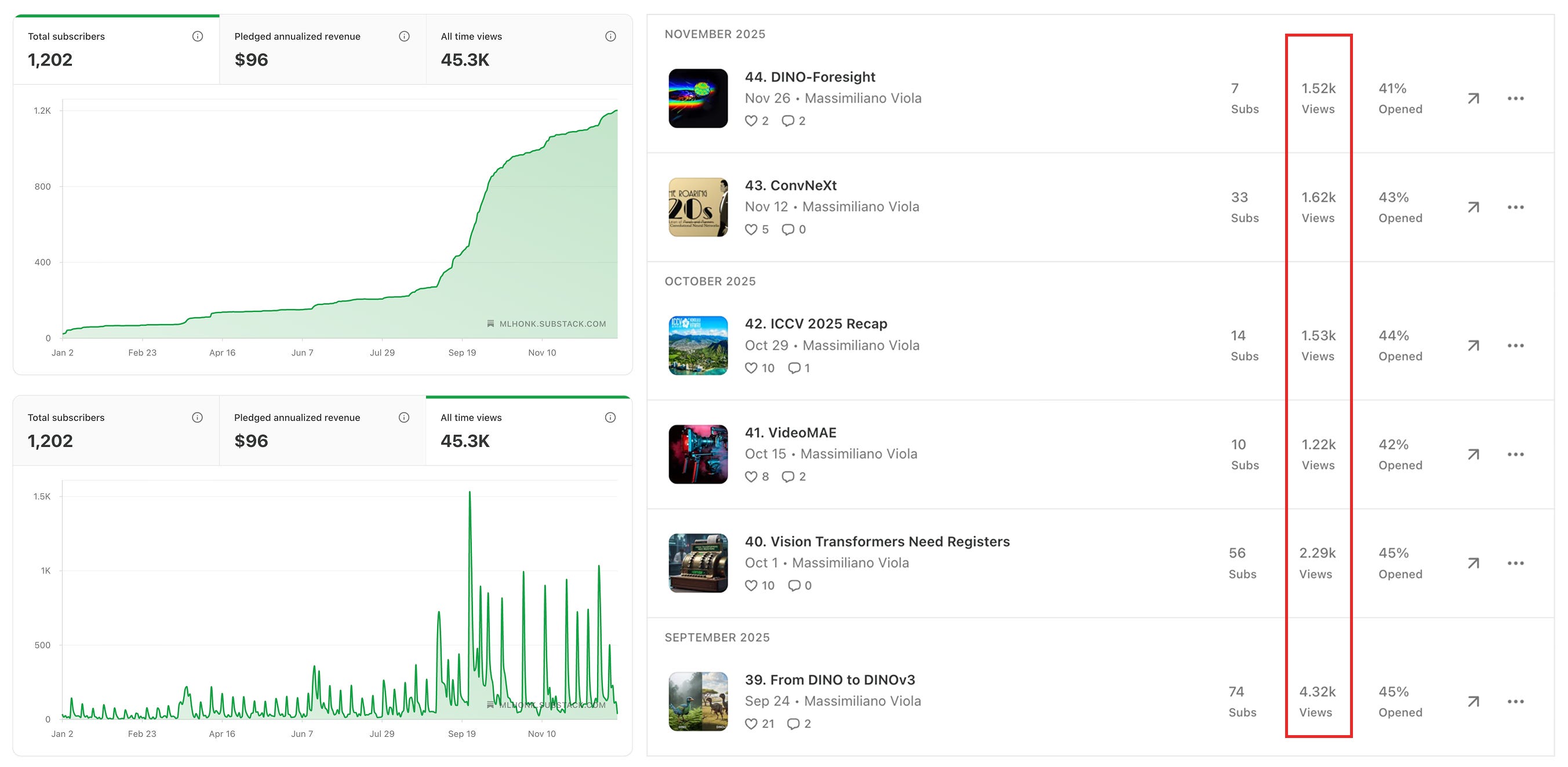
To promote these articles, I started posting on social media (LinkedIn and, more recently, X), gaining over 10k followers and generating 2.5M organic impressions. These results surpassed any projection I had made, even just a few months ago. As you can see, in all cases the growth has been explosive since around August, and I am sure this is only the start of something much bigger.
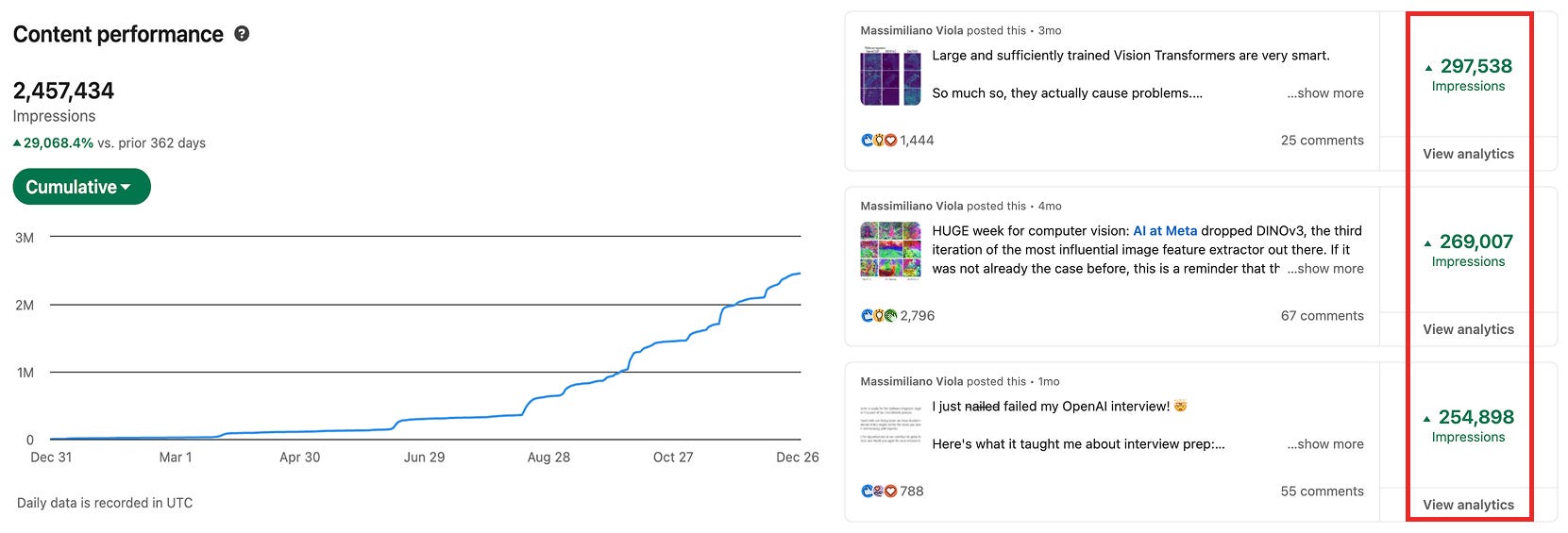
As for the most popular posts there, Vision Transformers generated the most interest, with my interview failures and Italian croissants sitting right behind them. Well… it is all part of the game! Beyond writing, I also sharpened my Figma skills, which is nice.
Overall, the lesson here is simple: you can just do things! You can talk about research even if you do not have a PhD. You can share your perspective on a field even if you are still learning yourself. You can start posting once a week and build an audience even if you have not pressed post in years. It might be difficult at first, but consistency always pays off.
What can be done better?
Cool, now let’s move on to the not-so-good news: with no surprise, all of this demands a significant time investment! While I have developed a consistent routine for writing, and it has gotten easier over time, this is not a task you can improvise at the last minute. Beyond the first draft, the process includes proofreading, creating visuals, researching future topics, and planning social media advertisements.
I knew what to expect when I started this, but there have been occasions when this whole process took excessively long, becoming frustrating as deadlines approached. To add another element to the mix, there is the reach. While a single article here might reach a few thousand people via email, several of my top LinkedIn posts reached hundreds of thousands of people. This difference makes me question if polishing full articles is always the most effective use of my time. Here are the questions I raised, and the answers I found.
Why not focus only on social media? That would both save me time and accelerate growth. Well, the truth is, I would be the first person to stop reading the research in detail for the sake of higher engagement. I do not consider this a good path forward, as I really like the learning aspect of breaking research down into digestible pieces.
But why not social media for some papers and the newsletter for others? This is a healthier option. It would reduce the workload and stress during certain weeks when I don’t feel like I can make it, and it provides the chance to go through my backlog to stay ahead. If done right and with the same spirit, this hopefully remains valuable for you while enabling me to pursue the other projects I will explain in a moment.
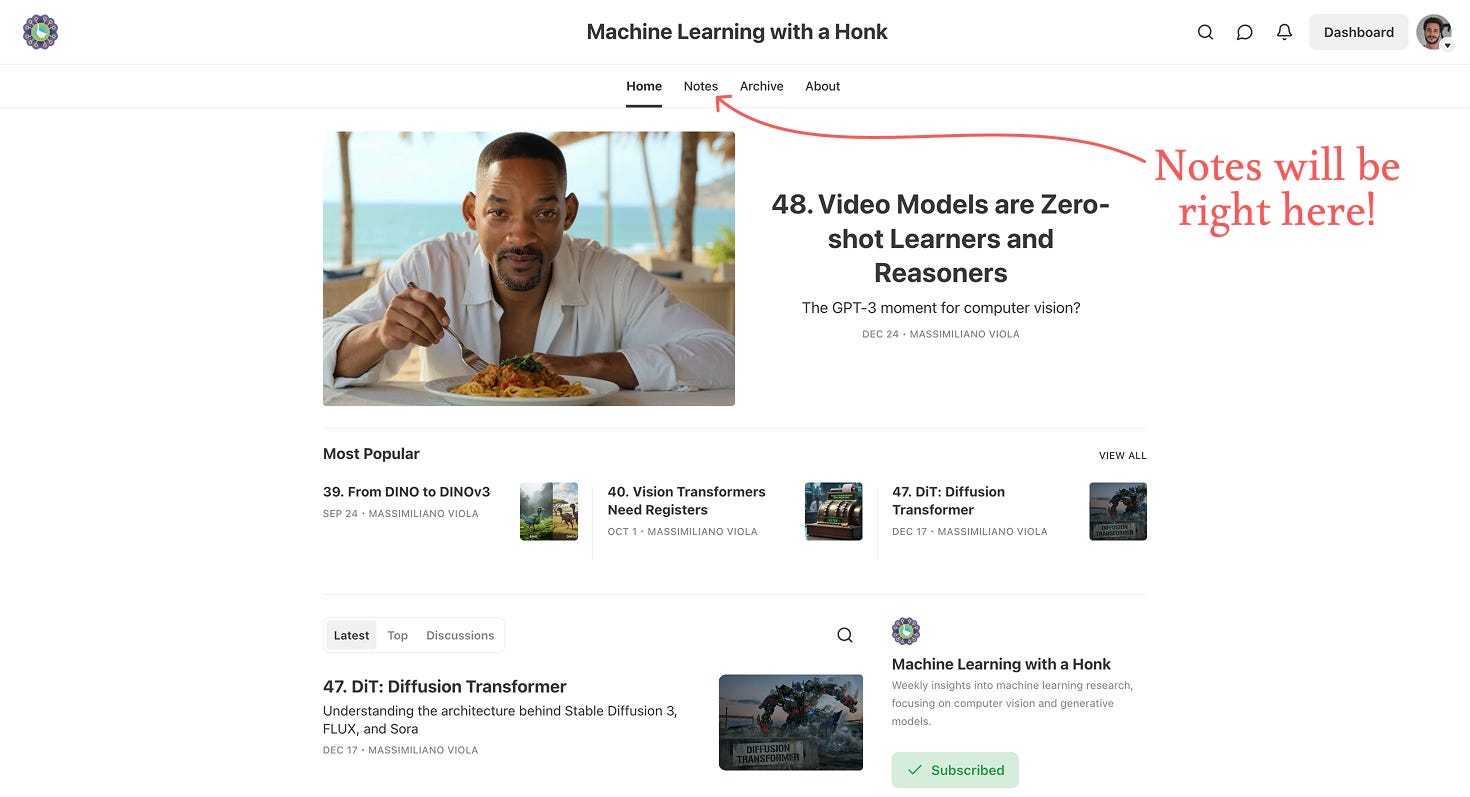
As you might have noticed recently, I have already started making my social media posts more detailed. At times, these posts effectively communicate the core takeaways of a ten-minute article, but they remain straight to the point. This will be the style, so I am curious to hear your feedback. I will also publish these as notes directly here on Substack to keep them accessible and easy to reference.
Moving on, I want to reflect on my original set of goals for Machine Learning with a Honk. In the first posts, I wrote:
I’m starting “Machine Learning with a Honk” to break down interesting research papers, showcase real-world AI applications, foster discussion, spark curiosity, and connect with people beyond my usual professional and social circles. Along the way, I hope to continue learning and sharing in equal measure.Let me say, this aged well for the most part. I definitely learned a lot about how to express myself, gained confidence by revisiting topics I thought I already understood, and connected with people from around the world on an unprecedented scale. I hope you also learned something new, gained a fresh perspective, and enjoyed the ride.
But here’s what I am not fully satisfied with: I never showcased these real-world AI applications, at least not the way I originally intended. To me, those are cool projects that bridge research with reality, and show what really happens to a great paper once it leaves a conference venue. I had multiple ideas about this and yet never found the time to sit down and research them as I intended. This realization drives the second change in my strategy, which is taking up more coding projects.
This also comes after spending six months in the Bay Area, where my brain was rewired into builder mode. I went to back-to-back hackathons every single weekend, had a lot of fun vibe coding a ton of things, and genuinely want to keep that streak going. Sharing these weekend projects alongside research papers will allow me to stretch further into the practical side, which is equally important.
So, what is happening next?
At the current time, I can say I plan to reduce the publishing frequency of the main newsletter to double down on building, both publicly and privately. In parallel, I want to keep delivering the best in-depth content and do more ambitious write-ups, which simply takes more time. Hence, the choice to split the paper breakdowns between social media and this platform. That being said, this is what you will still get:
At least two high-quality posts every month. These will be the classical in-depth analyses, where I explain the core mechanics of a paper and why those specific findings matter for the field. By moving away from a strict weekly schedule, I can curate more comparisons between different approaches and provide a recap of entire lines of work, helping you see the bigger picture. I have already planned several topics, including the SAM to SAM 3 evolution (following the success of DINO to DINOv3 saga) and a recap of feature super-resolution methods.
One paper every other week shared on social media and Substack notes. This is a way to stay connected to the fast pace of the industry, spread core or recurrent ideas, and keep the conversation going without the overhead of a full article. Make sure not to miss those and all the intermediate project updates by following on LinkedIn and/or on X.
More building, but without a fixed schedule. With clean code (hopefully) posted on GitHub, maybe a long-form post breaking down what was done, and a look at the technical hurdles I faced along the way. The general idea will be to maximize exploration (e.g., RL and post-training, multimodality, large-scale training). These are areas in which even young researchers are now expected to demonstrate at least some proficiency. In my small world and with my limited budget, I want to find creative ways to gain this experience and share them with you. Remember, theoretical knowledge only gets you one foot in the door :)
I hope all of this makes sense, so let’s see how this goes! I genuinely need some space to explore, and if this experiment doesn’t work out, going back to the past schedule is always possible. Anyway, thanks again for all the support in 2025, and wish you all a happy and successful new year… with a honk!